
Happy World Ocean’s Day!!
Are you considering a trip to Sea World? Before doing so, take a moment to watch the new full length trailer released by CNN films of Blackfish.
Blackfish is the Sundance decuting film about killer whales in captivity and their propensity of living up to their namesake.
The haunting footage revolves mostly around one whale, Tilikum, responsible for the very public and very horrifying death of a Sea World trainer in 2010.
Are these animals truly killers, or did we make them into killers when we stuck them inside a tank and made them perform for crowds? That seems to be the essential question at the heart of Gabriela Cowperthwaite’s unsettling documentary.
Watch the trailer for Blackfish:
Blackfish opens in limited release July 19. Here’s the official synopsis:
Many of us have experienced the excitement and awe of watching 8,000 pound orcas, or “killer whales,” soar out of the water and fly through the air at sea parks, as if in perfect harmony with their trainers. Yet, in our contemporary lore this mighty black and white mammal is like a two-faced Janus—beloved as a majestic, friendly giant yet infamous for its capacity to kill viciously. Blackfish unravels the complexities of this dichotomy, employing the story of notorious performing whale Tilikum, who—unlike any orca in the wild—has taken the lives of several people while in captivity. So what exactly went wrong?
Shocking, never before seen footage and riveting interviews with trainers and experts manifest the orca’s extraordinary nature, the species’ cruel treatment in captivity over the last four decades and the growing disillusionment of workers who were misled and endangered by the highly profitable sea-park industry. This emotionally wrenching, tautly structured story challenges us to consider our relationship to nature and reveals how little we humans have learned from these highly intelligent and enormously sentient fellow mammals.
In many animal societies, if a member of a group is gravely wounded or born with disabling deformities, that animal becomes an unsustainable burden on the others, and is often left behind at the mercy of predators, hunger and disease.
Not so with killer whales. They are among the few species in the world to look after members of their family who cannot look after themselves. Their patience and compassion for each other surpasses, perhaps, even that of humans
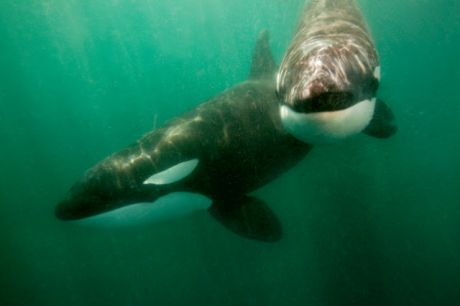
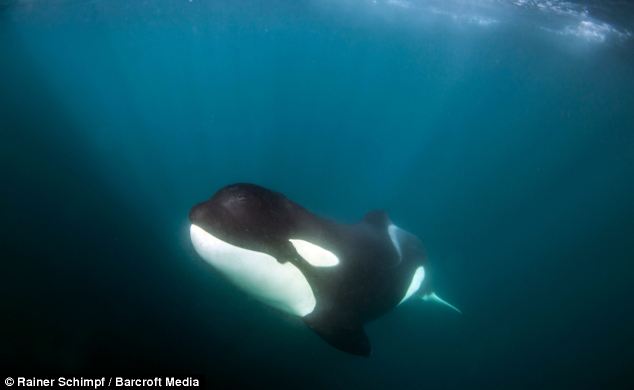
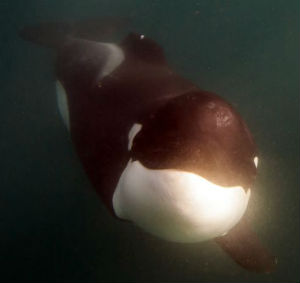
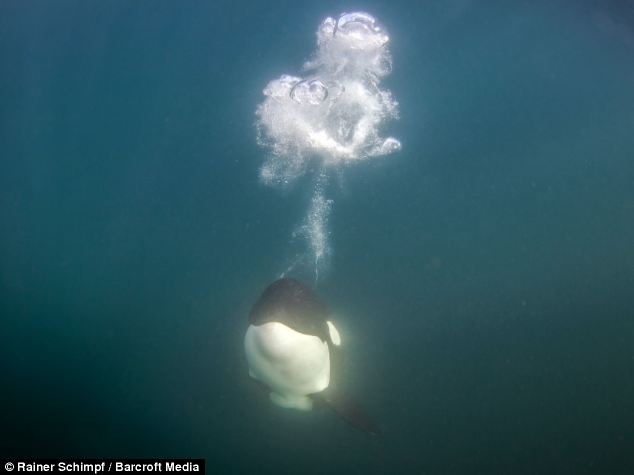
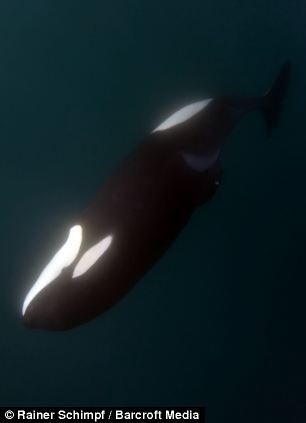
The most recent example of this extraordinary commitment to one another was revealed recently in the UK’s Daily Mail, which ran a story and photo essay of a disabled young male orca off the coast of South Africa. The disabled killer whale that is missing two fins is able to survive in the wild with the help of its family, who hunt food its food. The young killer whale has no dorsal fin or right-side pectoral fin, leaving it unable to hunt for itself.
These disfigurements make it impossible for the whale to hunt alongside his pod. Luckily for him, they are only too willing to hunt for their disabled pod mate.
Underwater photographer Rainer Schimpf came face to face with the pod while the members hunted in waters off Port Elizabeth in South Africa. He said: “Incapable of fast hunting and ambushing prey it has to be dependent on the pod which, one assumes, looks after it very well. It shows these mammals are not really just ruthless killing machines but they also have complex, caring social-structures in which they and care for their own disabled members.”

Of course, the more you learn about the intelligence, compassion and complex social bonds these amazing animals have developed over millions of years of evolution, the idea of keeping them locked up in tanks for human entertainment and profit becomes even more ludicrous.
Killer whales are highly social; some pods are composed of matrilineal family groups which are the most stable of any animal species. Killer Whales are notable for these complex societies. Only elephants and higher primates, such as humans, live in comparably complex social structures. It is because of these complex social bonds and society that one should wonder why we attempt keep Killer Whales in captivity.
Captivity is about separation and exclusion. It is about the destruction of families and communities. For wild caught animals, many watch their parents and family killed in front of them at a young age so that they won’t be able to put up a fight to defend them from capture. For the animals bred in captivity at Marineland, those parents routinely watch as their offspring suffer and die in infancy.
There are no heart warming stories at Marineland, Niagara Falls, Canada. There are endless sad stories, but none may be more pressing and sad than that of Kiska. Marineland’s last remaining Orca, Kiska was wild caught from Iceland in the 1980’s. At Marineland, Kiska is the longest serving resident and she has seen dozens of Orcas come and go – and estimated 14 other Orcas die. Of those 14, 5 of them have been her own children. The oldest surviving just 6 years. (Source)
Since the removal of Ikaika back to SeaWorld she has spent her days alone. Ex-trainers have spoken publicly about their concern for her and Marineland itself have gone on public legal record establishing their concern for the health of their lone Orca held in solitary. (Source)
Kiska’s story is the story of captivity. She has survived, but at what cost? Her life has been painfully sad, she is alone and completely dependent upon humans – humans who are only interested in her as an “asset.”
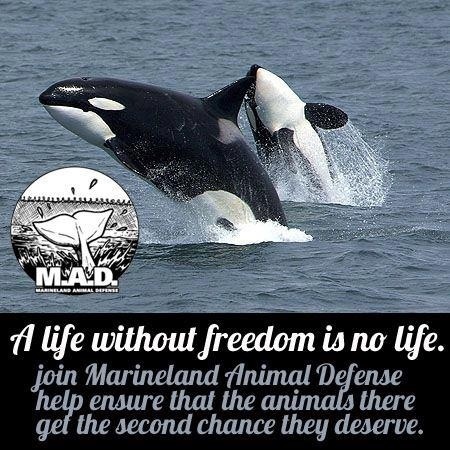
There is no human need to hold other animals in captivity. There is no human need to gawk at or to turn other animals into mere commodities and spectacles. Marineland Animal Defense fights to remove Kiska and all of the other animals at Marineland and to ensure there are no more captives!
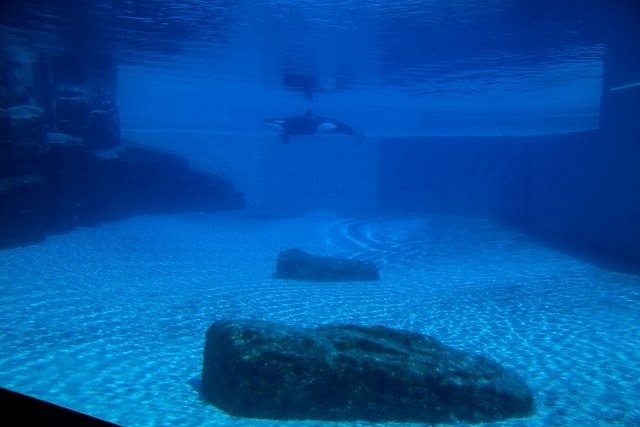
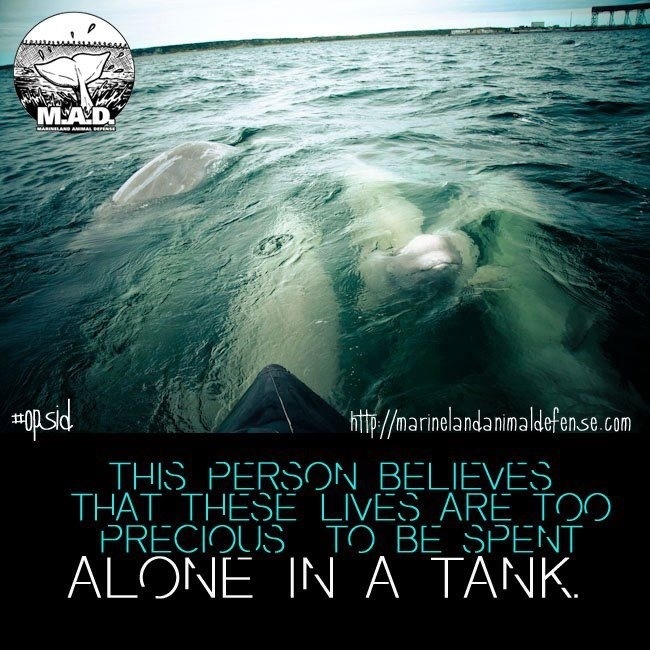
Kiska alone in her tank.
Sharkwater: For filmmaker Rob Stewart, exploring sharks began as an underwater adventure. What it turned into was a beautiful and dangerous life journey into the balance of life on earth. riven by passion fed from a lifelong fascination with sharks, Stewart debunks historical stereotypes and media depictions of sharks as bloodthirsty, man-eating monsters and reveals the reality of sharks as pillars in the evolution of the seas. Filmed in visually stunning, high definition video, Sharkwater takes you into the most shark rich waters of the world, exposing the exploitation and corruption surrounding the world’s shark populations in the marine reserves of Cocos Island, Costa Rica and the Galapagos Islands, Ecuador.
The Whale: tells the true story of a young, wild killer whale – an orca – nicknamed Luna, who lost contact with his family on the coast of British Columbia and turned up alone in a narrow stretch of sea between mountains, a place called Nootka Sound. Orcas are social. They live with their families all their lives. An orca who gets separated usually just fades away and dies. Luna was alone, but he didn’t fade away. There weren’t any familiar orcas in Nootka Sound, but there were people, in boats and on the shore. So he started trying to make contact. And people welcomed him. Most of them. This contact did not turn out to be simple. It was as if we humans weren’t ready for him. THE WHALE celebrates the life of a smart, friendly, determined, transcendent being from the other world of the sea who appeared among us like a promise out of the blue: that the greatest secrets in life are still to be discovered.
Eco-Pirate: The Story of Paul Watson: “Eco-Pirate” tells the story of a man on a mission to save the planet and its oceans. The film follows professional radical ecologist, Captain Paul Watson as he repeatedly flouts the law, so that he may apprehend what he sees as the more serious law-breakers: the illegal poachers of the world. Using verité sequences shot aboard his ship as a framing device, the documentary examines Watson’s personal history as an activist through archival footage and interviews, while revealing the impact of this relentless pursuit on his personal life. From the genesis of Greenpeace to sinking a pirate whaling ship off Portugal, and from clashes with fisherman in the Galapagos to Watson’s recent headline-grabbing battles with the Japanese whaling fleet in Antarctica, the film chronicles the extraordinary life of the most controversial figure in the environmental movement; the heroics, the ego, the urgency of the world’s original eco-pirate.
For the oceans!
Marineland whistleblowers need your help!
To date, 15 ex-employees have bravely spoken out about Marineland’s poor treatment of animals; and now the corporation has taken legal action against two. On Oct 17th, Christine Santos was fired after not signing a document that included a statement she’d never seen animal abuse at the park. Shortly thereafter, Marineland served a $1.25 million defamation lawsuit against the former trainer for telling the Toronto Star a killer whale was sporadically bleeding from its tail. Kiska, Marineland’s lone killer whale is now without her most trusted trainer. On Feb 13th Marineland launched a separate suit against Phil Demers citing $1.5 million in damages, with more suits expected.
If you are able to please consider making a donation by clicking here Any and all proceeds will be provided solely for the expenses incurred in defending any whistleblowers and any unused proceeds will be dedicate tot he continued avocation for Ontario’s captive animals.
Tweet Storm for Marineland Whistleblowers March 20, 2013 – click here for the Facebook page and more information
Spread the word: Tweet storm for #marineland #Whistleblowers on March 20 #SaveMarinelandAnimals
Support Marineland Whistleblowers by signing this petition: Save Marineland Animals
Watch this informative video – Behind the scenes at Marineland – Phil Demers former Marineland Trainer
For all the animals of Marineland!
 Voice For The Blue