#WhaleWednesday – Orcas

2015-08-OrcasPugetSound-0029-3

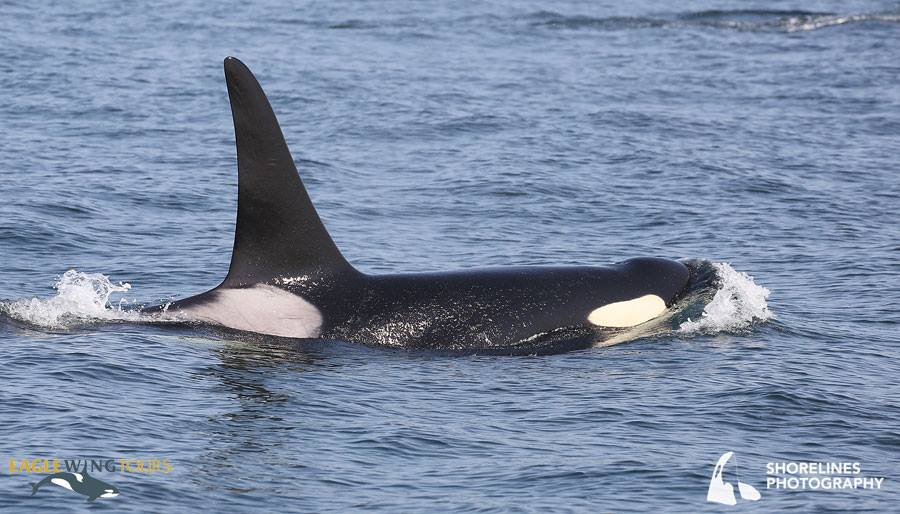
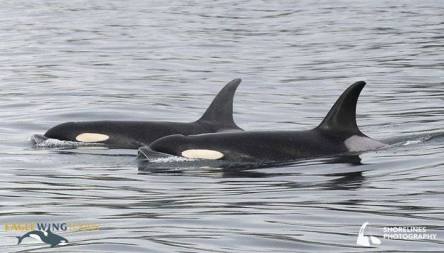
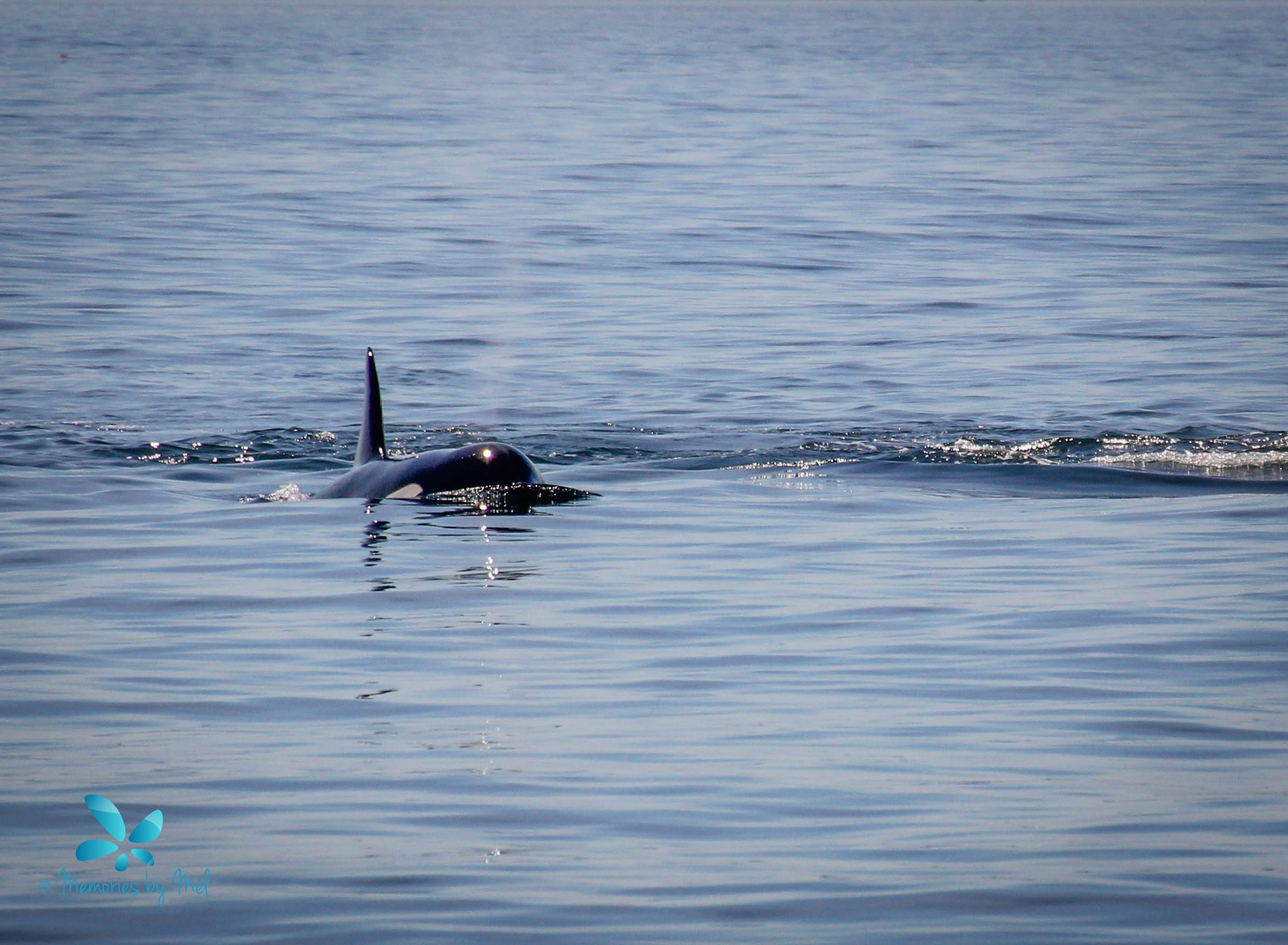
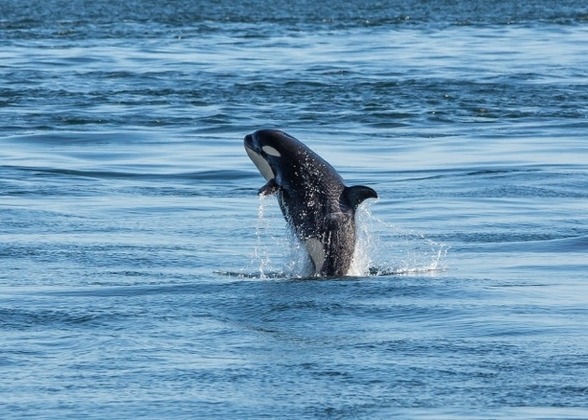
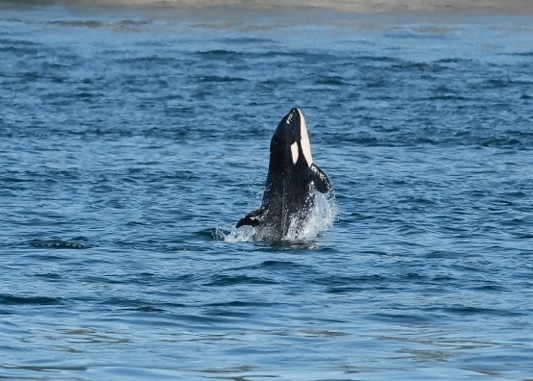
Transient Orca in Puget Sound – Photo Credit: Mel Komus Photography

Orcas (Orcinus orca) often referred to as, Killer whales, get their name from their reputation of being ferocious predators, exhibiting almost hateful behaviors when toying with their prey.  Interestingly, however, killer whales are not true whales.  They are very large dolphins, reaching lengths of 33 feet (10 m) and weights of at least 10 metric tones (22,000 pounds).  Killer whales and other dolphins are thought to be some of the smartest animals on the planet, challenging the great apes (chimps and gorillas) for the top spot.  They are also extremely curious and often approach people to investigate.  Their intelligence is likely both a result of and a driver of their complex social structures.  They are intelligent, playful, powerful animals – a worrisome combination if you happen to be their preferred prey.  Different killer whale populations specialize on different prey types, including large bony fishes; seals, sea lions, and other large marine mammals; and penguins; among other things.
15181398_1335736556466073_6071390181821454554_n

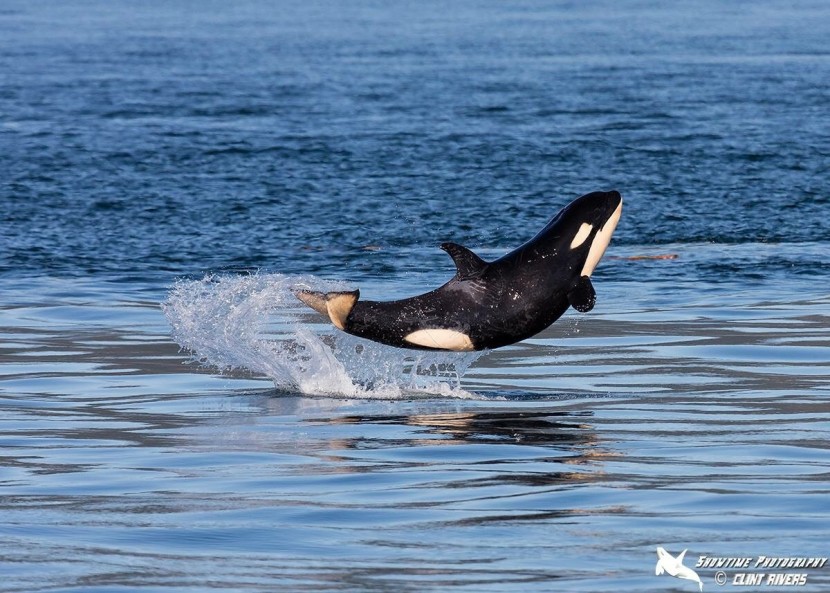
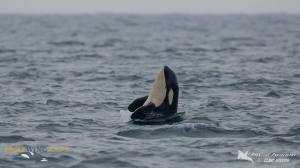
J52 Sonic of the Southern Resident Killer Whale Population takes to the air – Photo Credit: Clint Rivers Showtime Photography

Though all killer whales, worldwide, are considered to be members of the same species, there are several known populations that have slightly different appearances, sizes, and behaviors.  These include populations that are somewhat territorial and do not migrate long distances (the so called resident populations) and those that are more migratory in nature (the so called transient populations).  Furthermore, some transient populations stay near the coast and overlap with resident populations, while others are oceanic.  Some killer whale scientists believe that these populations may represent different species, and recent research suggests that there may be as many as 16 different species of Killer Whale.  To date, the new species have yet to be described, and the cosmopolitan species Orcinus orca is considered to cover all individuals around the world, regardless of behavior or appearance.
13423718_1190838637622533_2143167257701370693_n

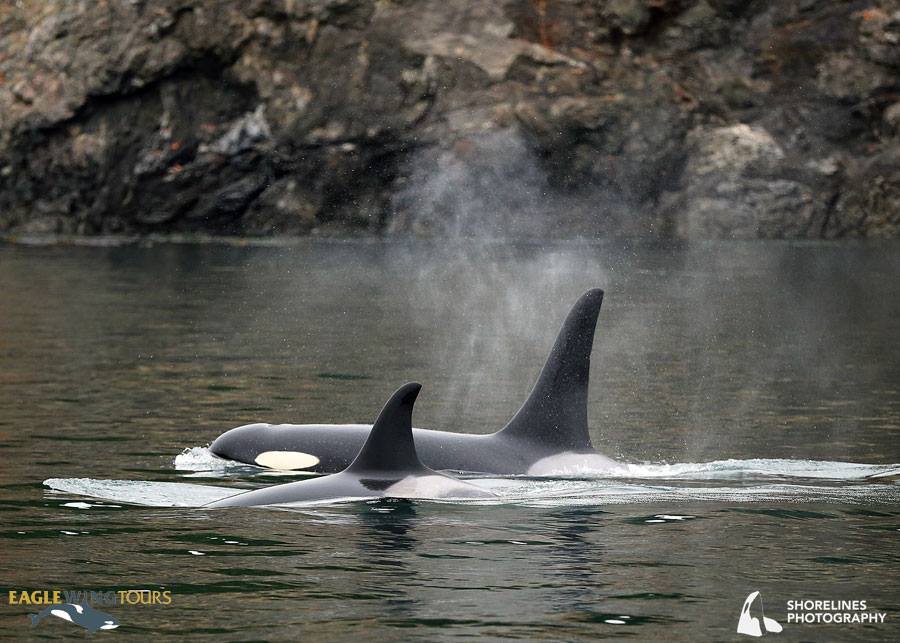
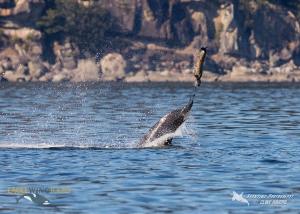
T036A’s and T075B’s playing with their food – a tail flick sent the Harbour Seal skipping off the water. Photo credit: Clint Rivers Showtime Photography

Though they are powerful hunters and are known to exhibit somewhat tortuous behavior towards large sharks and other marine mammals, killer whales have never been known to attack humans in the wild.  This is a somewhat puzzling lack of aggressive behavior, as people would be extremely easy prey for this species.  In captivity, however, male killer whales have killed several trainers in the last few decades.  These large, marine predators are not meant to be kept in small tanks in captivity, and they seem to eventually snap and exhibit aggressive behaviors toward their handlers.  In addition to their capture for display in public aquariums, low numbers of killer whales have been regularly hunted for food in some regions around the world.
2015-08-OrcasPugetSound-0038-3

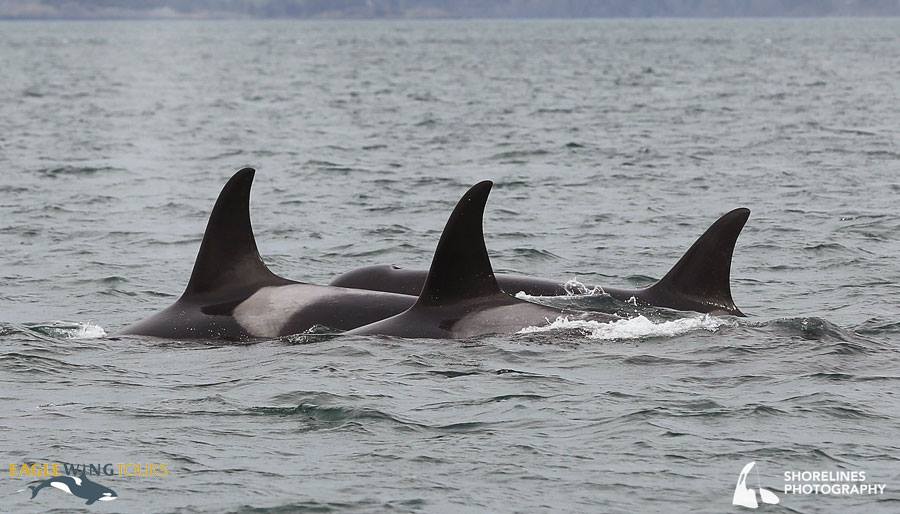
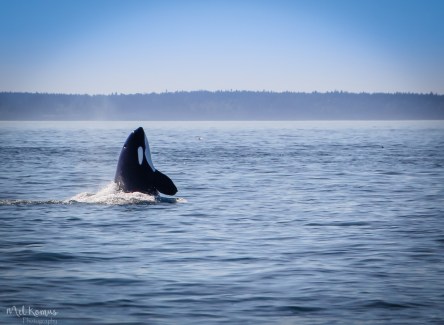
Transient Orca in Puget Sound – Photo Credit: Mel Komus Photography

Racing Extinction – Southern Resident Killer Whale Population

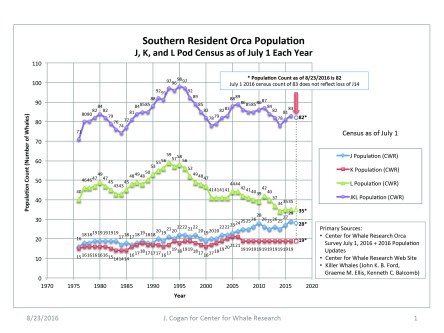
When it comes to the Southern Resident Killer Whales (SRKW) a year has made all the difference in the world. Last year at this time, we were all celebrating a remarkable baby boom, with 8 new orca calves over the previous 12 months & another new baby was added in January 2016, for a total of 9.

However, if 2015 was considered the baby boom year, then 2016 was the exact opposite with a total of 6 orca deaths recorded during the calendar year. Then the announcement on January 2, 2017 of J2 Granny’s presumed death  as of December 31, 2016. J2 Granny was last seen by the Center for Whale Research on October 12, 2016.

j2

J2 Granny

In 2016 we saw the loss of L95, J55, J14, J28, J54, & J34

l95

L95 Nigel

j14

J14 Samish – left with daughters J37 & J40

j28-j54-2

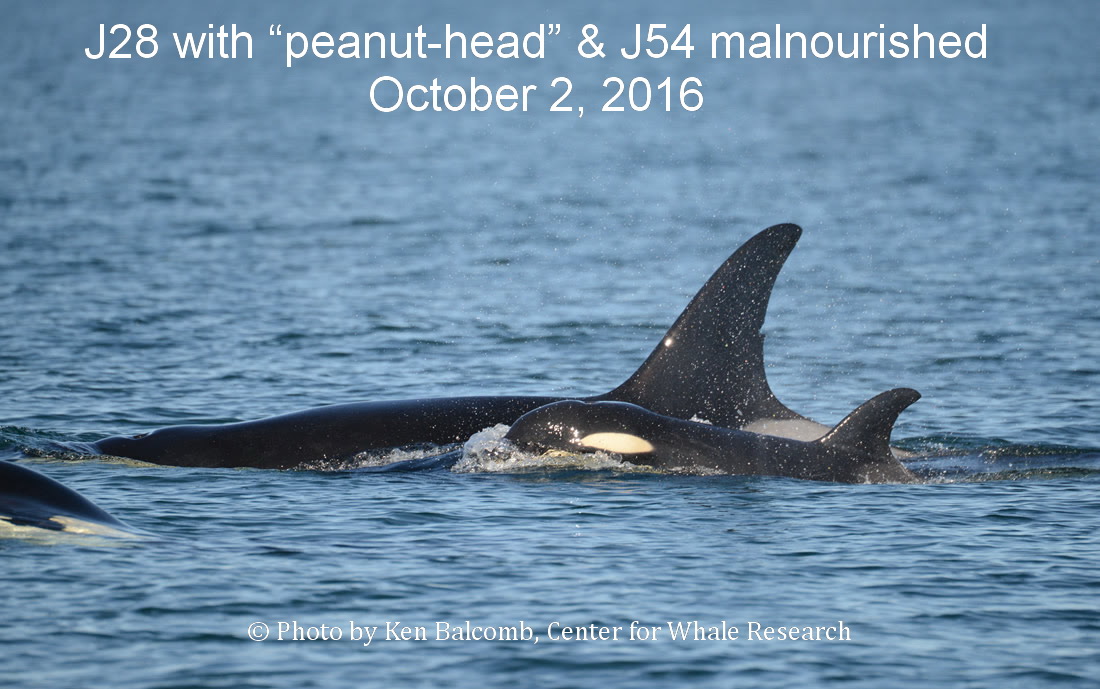
J28 Polaris and then her baby son J54 Dipper.

j34

J34 Doublestuf with mom J22

“The SRKW population is now estimated to be 78 as of 31 December 2016, and J pod contains only 24 individuals plus the wandering L87. To whom will he attach now? Who will lead the pod into the future? Is there a future without food? What will the human leaders do?” Ken Balcomb – Center for Whale Research

We are now racing the extinction of the SRKW’s – What it is going to take…

  • Heightened awareness and continued education
  • Sustainable fisheries and healthy wild Pacific Salmon stocks
  • Continued research into understanding where the whales go in the winter & what they do
  • Improved technologies for boating
  • Continued education for younger generations-the next group of Salish Sea ambassadors!!
  • Ongoing efforts to foster & promote ethical boating etiquette amongst all user groups: fishing – both private and commercial, kayaking, sailing, seaplanes, cruise ships, freighters, ferries, etc.

What can you DO to help:

  • Let Prime Minister Justin Trudeau know what his approval of the Kinder Morgan Trans Mountain pipeline expansion means for the endangered SRKW’s – say no to the Kinder Morgan pipeline and say yes to saving Orca’s
  • Please visit the David Suzuki Foundation – find your MP and send a message to Prime Minister Justin Trudeau, Catherine McKenna (Minister of Environment and Climate Change) & Jim Carr (Minister of Natural Resources)

Eat Sustainable

Become a Member of the Center for Whale Research – follow them on Facebook & Twitter

Adopt a Whale – check out The Whale Museum for more information

Follow Dam Sense on Facebook and check out their website damsense.org

Tweet to help save the SRKW’s and tear down those dams

Read the following articles to learn more:

The Orcas are Starving by David Niewert Breach dams, or its game over for salmon by Jim Waddell

No Fish No Blackfish – RIP J28 Polaris

RIP J28 Polaris

Her loss is made even more tragic by the additional loss of her most recent calf J54. At less than a year old and still nursing, his survival is unlikely without his mother to feed him. He was last seen on October 23 and is now presumed deceased. This brings the year’s losses up to 4 (L95, J14, J28 and J54) and the population back down to 80.

More then ever, we need to look toward more fish as the primary solution in saving the endangered Southern Resident Killer Whale Population.

It is fairly simple … No Fish No Blackfish

j28-j54-10_2_2016

What can you DO to help:

Get Involved – volunteer for a shoreline cleanup in your area – tell organization why support or why you do not – write to your local government representative (send letters and emails)

Sign petitions:

Eat Sustainable

Become a Member of the Center for Whale Research – follow them on Facebook & Twitter

Adopt a Whale – check out The Whale Museum for more information

Follow Dam Sense on Facebook and check out their website damsense.org

Tweet to help save the SRKW’s

Read the following articles to learn more:


Help Save the Southern Resident Orca’s

It has recently been learned that J14 Samish of the Southern Resident Killer Whale Population (SRKW) is missing and presumed dead. It is highly unusual for an individual orca to go off by themselves and leave their pod, especially a matriarch. At only only 42 years old, the loss of J14 is a surprising one for J pod.

14080015_10153850980563730_3878555495632553519_n

Copyright Valerie Shore Shorelines Photography

With the loss of J14 there are now only 82 orca’s left of the SRKW population. The recent gains from last years baby boom are being diminished quickly – so far this year we have seen the loss of L95, J55 and now J14.

From recent sightings and reports it now appears that J28 Polaris (only 23 years old) is very ill and looking emaciated in a recent encounter. Emaciation is typical sign of illness and/or starvation and can be seen when a whale starts to develop what is referred to as a “peanut head” (a loss of blubber behind the base of the skull) and is usually an indicator that death is not far off.

“Things are shaping up to be pretty bad.” said Ken Balcomb of the Center for Whale Research ” J28 is looking super gaunt, and I would say she is within days of her death”

While occasionally whales do recover from this condition, the possible loss of J28 will likely mean the loss of her newest calf J54. At only 7 months old J54 is not ready to survive on his own. It is possible that he will be adopted by another female in the group J28’s mom J17 Princess Angeline or sister J35 Tahlequah.

14054448_10153852536153730_3949396922752334666_o

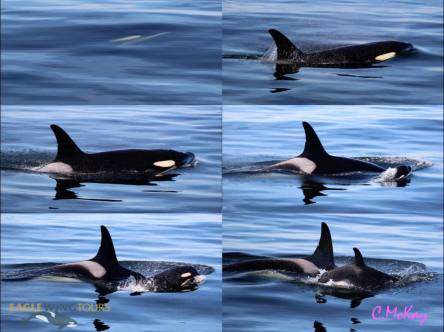
J28 Polaris approx 12 days ago Copyright Eagle Wing Tours Naturalist Corinne McKay

SRKW Population

What can you DO to help:

Get Involved – volunteer for a shoreline cleanup in your area – tell organization why support or why you do not – write to your local government representative (send letters and emails)

Sign petitions:

Eat Sustainable

Become a Member of the Center for Whale Research – follow them on Facebook & Twitter

Adopt a Whale – check out The Whale Museum for more information

Follow Dam Sense on Facebook and check out their website damsense.org

Tweet to help Take down the dams

Read the following articles to learn more:

Watch Free the Snake: Restoring America’s Greatest Salmon River – Jim Waddell lays out the reasons why the four lower Snake River dams must be breached

Orca’s Live on Explore.org

If you are unable to make it out to British Columbia, Canada to do some whale watching the next best thing is to check out the live-cams on explore.org

Explore.org offers many different live-cams: orcas, belugas, sharks, bears, elephants, even wild Bison in my home province of Saskatchewan Canada!

You can also sign up for text message alerts! Explore.org will text you when the orcas come into view on the live-cams.

Explore has also has an app available for download:  http://explore.org/apps/pages/explore_apps/

Here are some of my favourites to check out below.

Orcas off the coast of British Columbia:

Orcalab Base – http://explore.org/live-cams/player/orcalab-base

Caracroft point surface – http://explore.org/live-cams/player/orcalab-cracroft-point-surface

Rubbing Beach – http://explore.org/live-cams/player/orcalab-rubbing-beach

Rubbing Beach underwater – http://explore.org/live-cams/player/orcalab-rubbing-beach-underwater

orcalab base sunrise

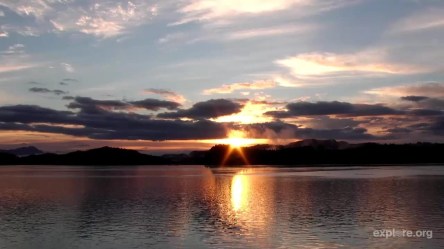
Sunrise on Orcalab Base live-cam

Belugas – Churchill River and Hudson Bay:

Beluga boat cam on deck – http://explore.org/live-cams/player/beluga-boat-cam-on-deck

Beluga boat cam underwater – http://explore.org/live-cams/player/beluga-boat-cam-underwater

belugas

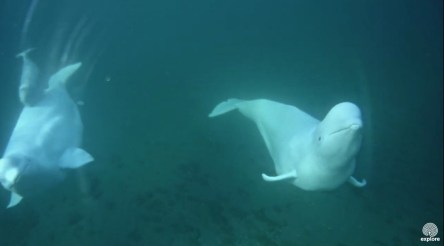
Beluga boat cam – underwater

Bears – Katamai National Park, Alaska:

Brooks Falls – Katamai National Park, Alaska – http://explore.org/live-cams/player/brown-bear-salmon-cam-brooks-falls

Brooks Falls

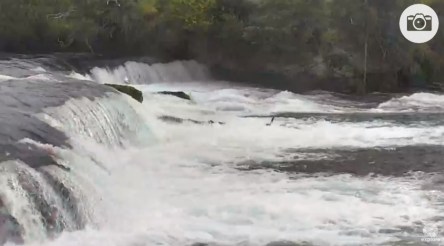
Brooks Falls Katamai National Park, Alaska


The Real Sea World – Victoria, BC

This past August was the first time I had the opportunity to see Orca’s in the wild and I have to say there is no other experience quite like it! It truly was an exhilarating, left me with the best natural high and a permanent smile for days!

I’ll be honest I have been to Sea World – a few times as a child and young adult. If documentaries like Blackfish and the Cove had been available back then I would never had made those trips. I do not regret those experiences, although I do wish there had been someone to say to me or teach me from a young age that these highly intelligent mammals do not belong in a concrete tank swimming in circles day in and day out, performing tricks in order to be fed. While I was growing up there was no such thing as social media – there was no Facebook, twitter or Instagram – what was a blog – if you wanted to write down your thoughts you did it in a journal that no one ever read. I owned my first computer at 18 and that was when I signed up for my first email address.  Now it is important to use every possible outlet available to educate today’s youth about the captive marine mammal industry. The end of Sea World, Marineland Canada and other such marine parks, will only end when the demand for it ends. If we teach the youth of today that it is wrong to keep Orcas, dolphins and whales, etc in tanks then hopefully the demand for it will slowly dissipate and we will one day see the tanks of Sea World and Marineland Canada emptied.

Now (with the help of social media) I have the ability to enlighten others about the captive industry, while also making them aware that there are better options available to view these marine mammals in the wild and on their own terms. I’ve had the opportunity to experience Orca’s in the wild – I’m pretty sure my next trip will be to experience dolphins in the wild. My only experience with wild dolphins to date was during my time in Taiji as a Cove Guardian, so seeing wild dolphins is definitely at the top of my bucket list!

Here are a few videos from my experience with Transient Orca’s off the coast of Victoria, BC this past summer. While these videos only offer you a short glimpse into my experience of whale watching hopefully they will inspire you to experience Orca’s in the wild for yourself.

Transient Orca’s in Puget Sound August 19, 2015

Transient Orca’s (T010’s) August 21, 2015

Hunger Strike for the protection of Humans & Marine Life in Queensland, Australia

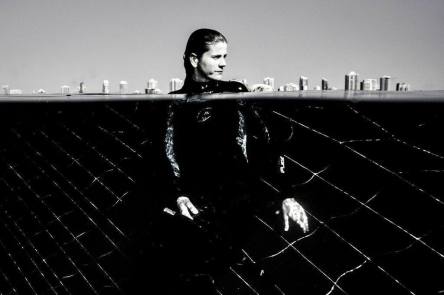
Fellow Cove Guardian alumni, marine conservation campaigner and underwater photographer, Nicole McLachlan, began a hunger strike (refraining the consumption of all food and liquid with the exception of water) on February 6th, 2016, with the ultimate goal of increasing the protection of both humans and marine life off the coast of Queensland, Australia.

http://www.nicoleshungerstrike.com/

The hunger strike will be conducted by Nicole  in order to:

  • Mobilize the Queensland and Australia-wide general public to urge the Queensland State Government to invest in non lethal alternatives to shark mitigation efforts within the state as well as phasing out lethal shark control methods.

  • Raise public awareness of and highlight the destruction caused by lethal shark control programs to both marine life and humans.

  • Encourage public support for non lethal alternatives to the current shark control program in Queensland.

Nicole will continue her her  hunger strike until the following policy changes and commitments are met by the Queensland State Government/ Department of Primary Industries.

  • A commitment of at least $16 million (to match the NSW State Governments’ recent commitment) into the trial and implementation of non-lethal alternatives along Queensland beaches (to ultimately replace shark nets and drum lines).

  • A commitment to phase out all shark nets along the Queensland coast within the year 2016. These nets are a high risk to beach goers and marine rescue crews and should be removed as soon as possible.

  • A commitment to phase out all drum lines off the Queensland coastline over 5 years, by replacing these with non lethal alternatives (e.g. shark spotters programs).

Please sign Nicole’s petition on Change.org:

https://www.change.org/p/protect-both-marine-life-and-humans-along-the-queensland-coast

Follow Nicole on Facebook:

https://www.facebook.com/nicolemclachlan.underthesea

Transient Orca’s in Puget Sound Summer 2015

Whale Watching in British Columbia is one of the best places in the world to view orcas, humpback whales, gray whales and other marine species. The city of Victoria and in particular the southern tip of Vancouver Island is renowned for orca sightings and is the ultimate destination for BC whale watching. Victoria is at the centre of the world’s highest concentration of killer whales. It’s perfectly situated in the middle of the southern resident killer whales’ seasonal feeding ground.

I spent a lot of time researching whale watching and looked at several different whale watching tour companies in Victoria. I finally decided to book with Eagle Wing Tours. Eagle Wing Tours is Victoria’s first award winning whale watching company and is the #1 ranked whale watching company in Victoria on TripAdvisor.

I was unsure of what to expect for my first whale watching tour, but all I knew was that it would be amazing to see wild orcas, even better to see them spyhopping, breaching and if I got to see a baby orca too then that would just be fantastic! Well turns out my first experience would not disappoint and I managed to see all of this in one trip!


2015-08-OrcasPugetSound-0047-2

2015-08-OrcasPugetSound-0015-2

2015-08-OrcasPugetSound-0018-2

2015-08-OrcasPugetSound-0042-2

2015-08-OrcasPugetSound-0039-4

2015-08-OrcasPugetSound-0036-2

2015-08-OrcasPugetSound-0029-4

2015-08-OrcasPugetSound-0031-2

If you ever have the opportunity to experience Orca’s in the wild – just do it! It is by far one of the most exhilarating experiences!

Japans Latest Tactics to Attempt to Hide the Bloodshed at The Cove

news-150827-1-1-CG-Karen-Hagen-900wSea Shepherd veteran crew member Karen Hagen of Norway has been denied entry into Japan to document the brutal capture and slaughter of dolphins and small whales in Taiji as Ground Leader of Sea Shepherd’s Operation Henkaku campaign, previously referred to as Operation Infinite Patience. On August 27, Hagen was detained by Japanese Immigration upon arrival in Fukuoka, Japan by ferry from Busan, South Korea. After being interrogated for nearly two hours and held for more than six hours, she was refused entry into the country and deported to South Korea. Hagen’s passport was taken and she was refused a phone call unless she identified the person she was calling and made the call on speaker phone in the presence of a Japanese translator. Initially, Immigration officials stated that entry was being denied because Hagen had a tourist visa and was not in the country for tourism. Upon being asked why taking photos did not qualify as tourism, officials changed their reason, stating that she did not have a return flight home. When Hagen showed her return ferry ticket, they then stated that last year she wrote that she would be staying in Japan for two weeks but stayed for two and a half months. She then pointed out that she had extended her stay, which is legal, and at that time no further reasons were given as to why she was being denied.


news-150830-1-1-Linda-Trapp-CG-900wOn August 30, Sea Shepherd veteran crew member Linda Trapp of the USA has been denied entry into Japan. Trapp was detained by Japanese Immigration upon arrival in Osaka, Japan. After being interrogated for nearly five hours, she was refused entry into the country. Japanese Immigration officials said the reason she was denied entry is that her activities are not consistent with those that fall under Japan’s “tourism clause.” Trapp, 56, is a two-year veteran Sea Shepherd crew member and a respected retired homicide detective with the Washington County Sheriff Department in Oregon, USA.


11109_10204415713726877_4776487435405937573_nThis is not the first time a Sea Shepherd volunteer has been refused entry to Japan; several returning Cove Guardians were detained and sent home upon their arrival to the country last season. In December 2014, then Senior Cove Guardian Campaign Leader Melissa Sehgal was interrogated for nearly nine hours and detained for 24 hours before being escorted onto a flight out of Japan. No reason has been given for the denials, but Japan has claimed that the volunteers arriving with tourist visas are not tourists. This pattern of entry denials is not unexpected, as Japan will go to great lengths to try and hide the bloodshed suffered by dolphins in the cove from the world. Furthermore, the denials are evidence that Japan knows Sea Shepherd has been effective in exposing these atrocities to the world.


FullSizeRenderOn August 31, Ric O’Barry, Founder/Director of Dolphin Project and subject of the documentary The Cove, was arrested in the town of Nachikatsuura, a town located in Wakayama Prefecture. O’Barry was arrested on suspicion of a violation of the Immigration Control and Refugee Recognition Act of Japan and was reportedly accused of being unable to produce a passport. Under Japanese law, any tourist in Japan is required to carry a passport with them at all times. After spending the night in jail O’Barry was released with all charges dropped, as several hours after impounding his vehicle, local police located his passport inside the car. O’Barry believes that the combination of elevated pressure on Taiji, and Japan’s, “extreme, right-wing, radical government,” is currently placing Westerners at risk. “They’re trying to get all Westerners,” he said, “and the orders are coming from higher up — not the local police. We have always had a good relationship with them.”


The 2015/2016 Dolphin drive hunt and slaughter officially began on September 1 and thanks to heavy rain and winds we have experiences two Blue Cove Days so far this season!

The Real SeaWorld: Baby J50 Makes a Splash #Blackfish

The Southern Resident Orca pod is making a comeback after almost three years without a successful birth, There has been a bit of a boom with four calves born since December 2014. The Orca calves, known as J50, J51, J52 and L121 can been seen frequently.

On July 4, whale watchers on an Eagle Wing Tours in Victoria got a show from J50. “J50 stole the show, and hearts, with more than 60 breaches as she and her family moved south in Haro Strait,” said Clint Rivers, a naturalist and photographer. “It’s like she just figured out how this breaching thing works and couldn’t stop. She was still breaching well into the evening.”

I’ll be making my first trip to Victoria in the near future and have decided to do not one but two whale watching tours with Eagle Wing Tours! It would be amazing to see one of the new Orca calves, however just having the opportunity to see these incredible mammals on their own terms and in their environment will be an experience of a life time. Stay tuned for photos from my trip – but for now enjoy the photos below of J50

bilde

© Clint Rivers, Eagle Wing Tours, Victoria, BC

bilde-1

© Clint Rivers, Eagle Wing Tours, Victoria, BC

tumblr_nr5f6oCmIZ1s1h0jxo1_1280-830x593

© Clint Rivers, Eagle Wing Tours, Victoria, BC

Reflections of a Cove Guardian #tweet4taiji

It has been over a year since I left Taiji and a year since I have managed to write a blog. I’ve been recently trying to get back into writing and was not quite sure how to come up with a good post, since it has been a significant amount of time since my last one. I’m sure I could come up with numerous reasons as to why I haven’t written anything as of late. But this is what I’ll tell you …

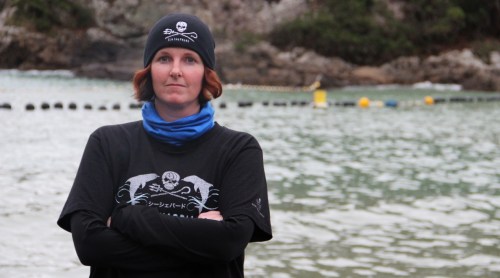
cropped-img_0611.jpgBeing in Taiji has an incredible effect on you. At times it’s hard to describe the emotions you feel and sometimes I’m certain the only people that truly understand the lasting effect of being in Taiji, are my fellow Cove Guardians. It is still one of the best things of done, one of my proudest moments and I would do it all over again in a heartbeat.
When I first arrived home from Taiji the first thing I did was sleep for almost 18 hours straight! Perhaps from the long travel time it took to actually get home .. I’ve never been one to sleep on airplanes! But more so because it was incredibly hard to go back to your hotel room every night in Taiji and attempt to shut off your mind. You have early mornings, which I’m used to being a morning person, You also have long days, depending on how fast or short the drive hunt is. But at the end of the day the horrific scenes and atrocities you witness seem to replay on a continuous loop in your mind. The dreadful scenes at the Cove are not something that can simply be unseen at the end of the day. Not to mention that after witnessing a slaughter or live capture you need to go through all of the images you shot that day and pick the best (i.e., the images showing the atrocious scenes of the day) so they can be posted to social media. For me I have to say its not just the images in my mind but it’s also the sounds you hear – the banger poles, the killers yelling & laughing, the screams of the dolphins fighting for their lives and the sound of a dolphin taking it’s last breathe before the eerie silence that tells you the slaughter is complete.

Once I was home I was eager to start posting on my blog and it seemed as though I had many things to say and share about my time in Taiji. It was easy to write about my experiences of the blue cove days to the red cove days to monitoring the captives at Dolphin Base and the Taiji Harbour Pens as well. It was not hard to come up with blog posts and the words sometimes seem to simply write themselves. After that, it was as if I didn’t know what to say or perhaps ran out of things to say, essentially the tap ran dry and the words were not flowing as they did before.

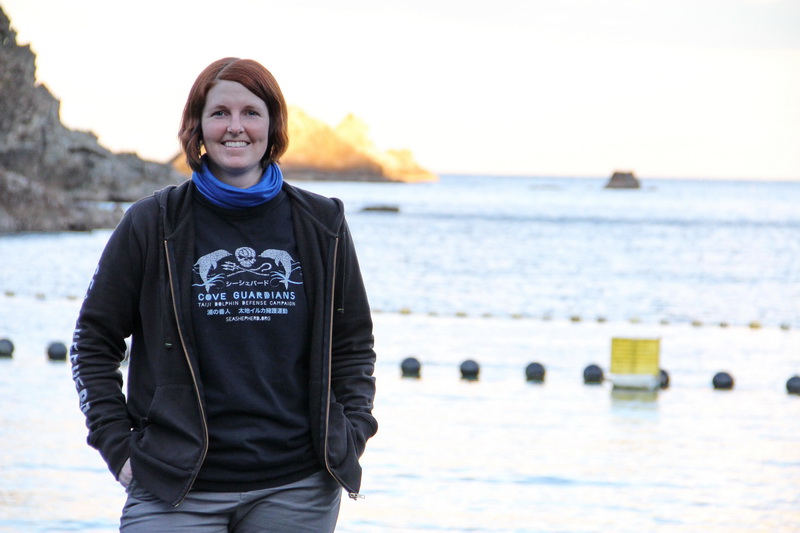
So I decided to take a step back for awhile – maybe longer that I anticipated. Now another dolphin hunting season in Taiji is about to come to an end and I am finally writing my first post in over in a year. I still follow the Cove Guardian campaign throughout the season – posting and sharing updates on Twitter and Facebook. I talk about the Cove Guardian campaign every chance I get and my two copies of the Cove documentary are passed out frequently to friends, family and staff members. I even wear my Cove Guardian t-shirt every Friday, as we do casual Fridays at my office and I like to refer to them as Cove Guardian Fridays! After almost two years of Cove Guardian Fridays I finally had a patient ask me where I got my shirt and he was surprised to find out that I had made the trip to Taiji to join the Cove Guardians.

Now the the words seem to be flowing and I once again find myself with the eagerness to write and continue informing people on the continuous atrocities that still happen at the cove. The fact that marine parks, Sea World and swim with the dolphin programs fuel the dolphin drive hunts every year. In the end some people may turn a blind eye to what continues to happen in Taiji, while others will continue to stand watch at the Cove and those people are the dedicated volunteers from all over the world who volunteer their time to join the Cove Guardians.

Please check out the video below to know more about what the Cove Guardians do on the ground while in Taiji

Melissa Seghal and her Sea Shepherd Cove Guardian team highlight the daily atrocities that occur against much beloved, intelligent and social dolphins in Taiji, Japan for six months of each year.

For the dolphins!

jane goodall 2

The Risso on the Rocks #tweet4taiji

It is a daunting task at times to witness and photograph the daily atrocities in Taiji. I’ve had many people comment on twitter or Facebook and ask how do Cove Guardians do this? Well first of all, when you make the decision to go to Taiji you are well aware of what you will be witnessing each day. There is really nothing you can do to prepare yourself for this either. For me, the only thing that helped was looking through the lens of my camera and trying to take as many photos as possible … as I’ve said before the camera really is a Cove Guardians only weapon. Of course being surrounded by fellow Cove Guardians, who share your passion and daily experiences, is comforting. We all travel to Taiji for the same reason: to be a voice for the dolphins. Doing this requires us to witness the tormenting, manhandling, and inhumane treatment of dolphins on a daily basis.

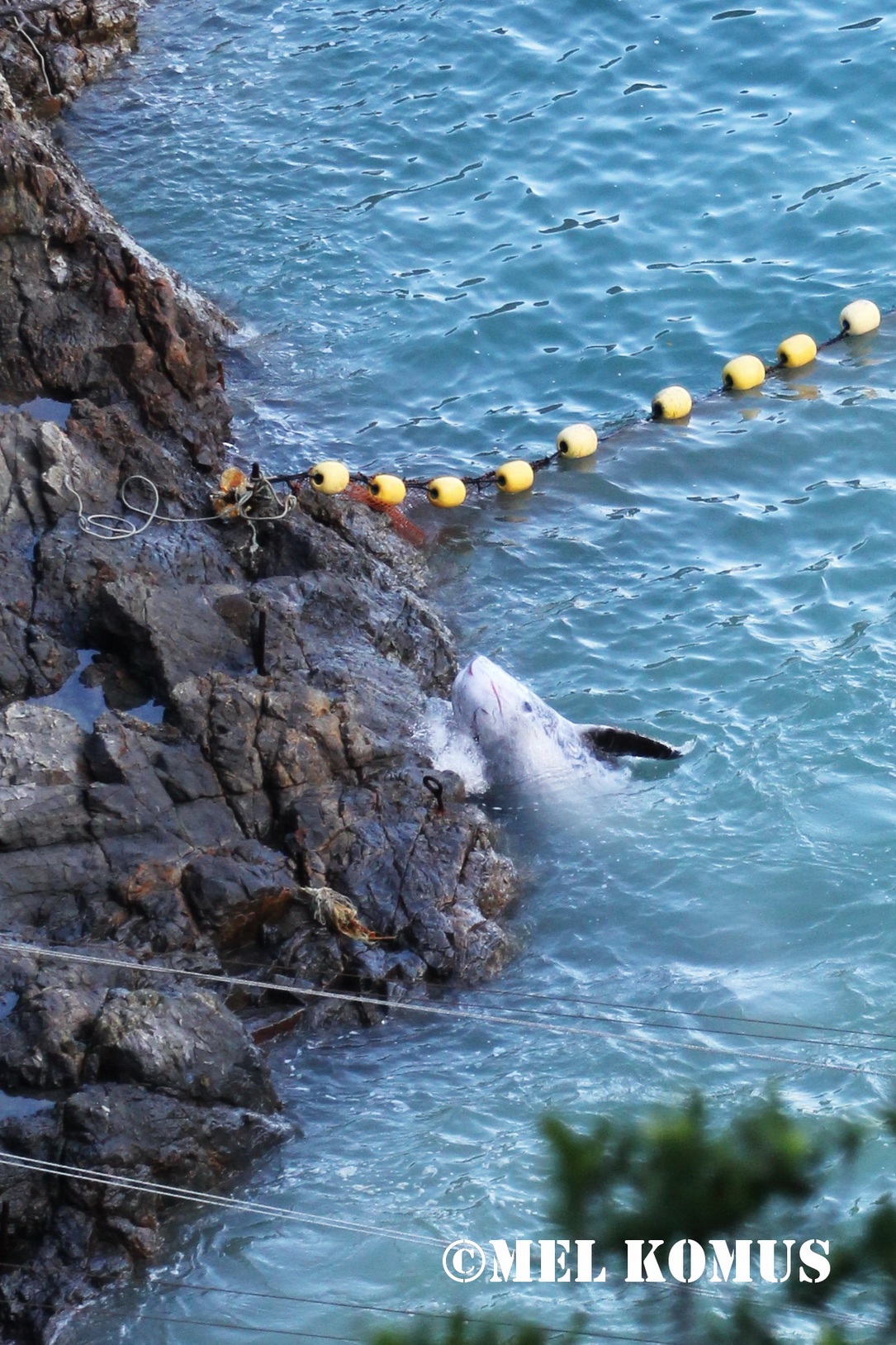
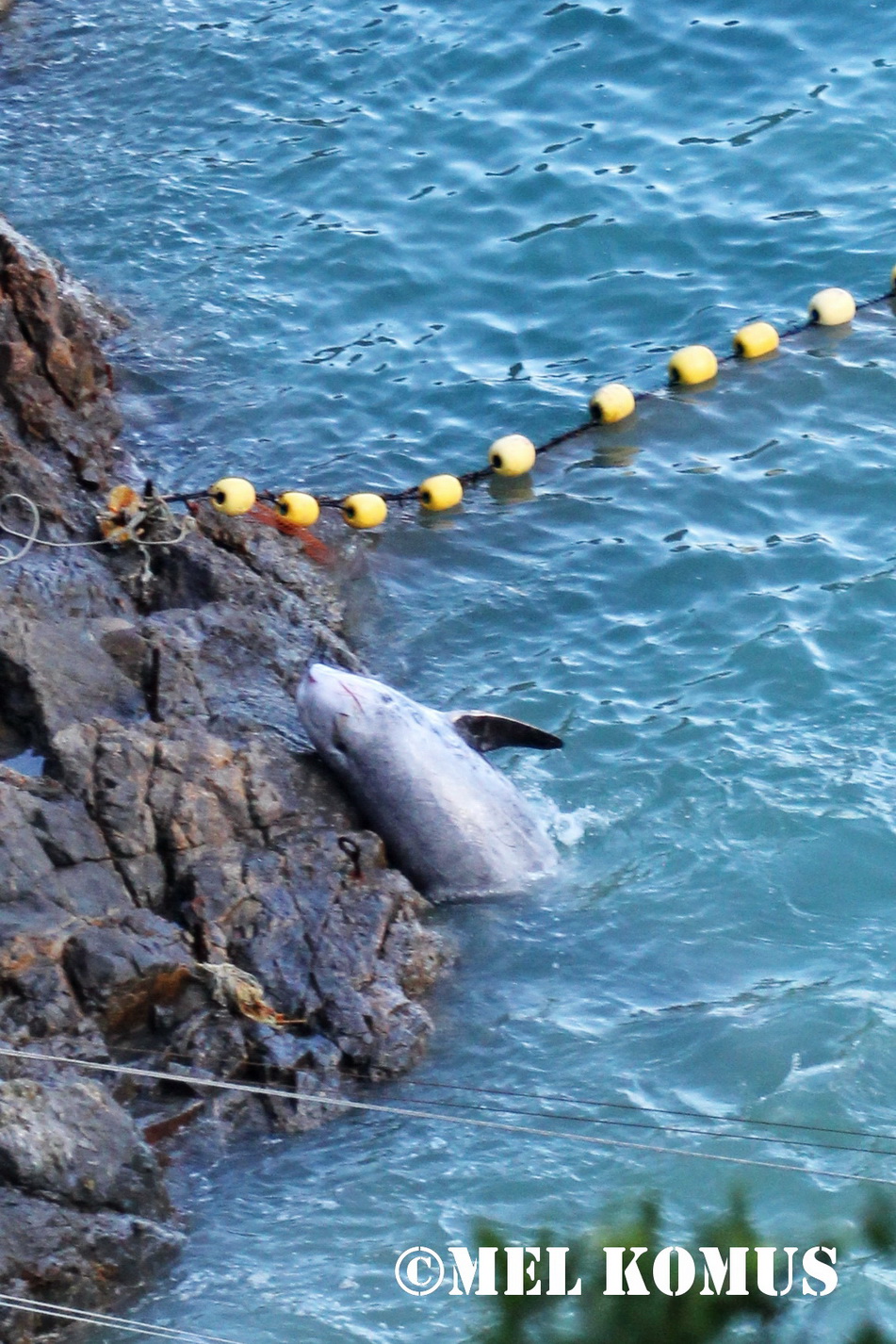
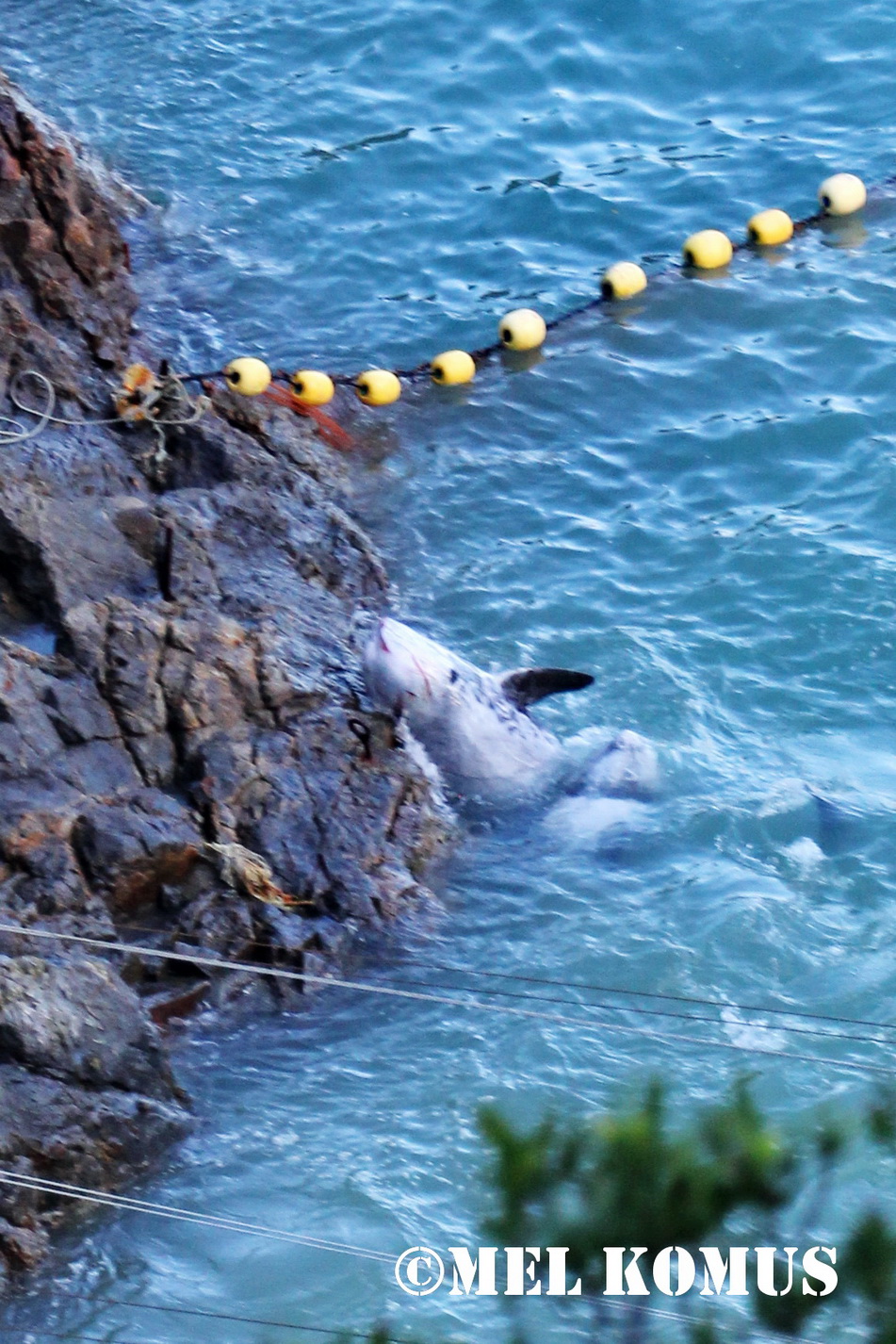
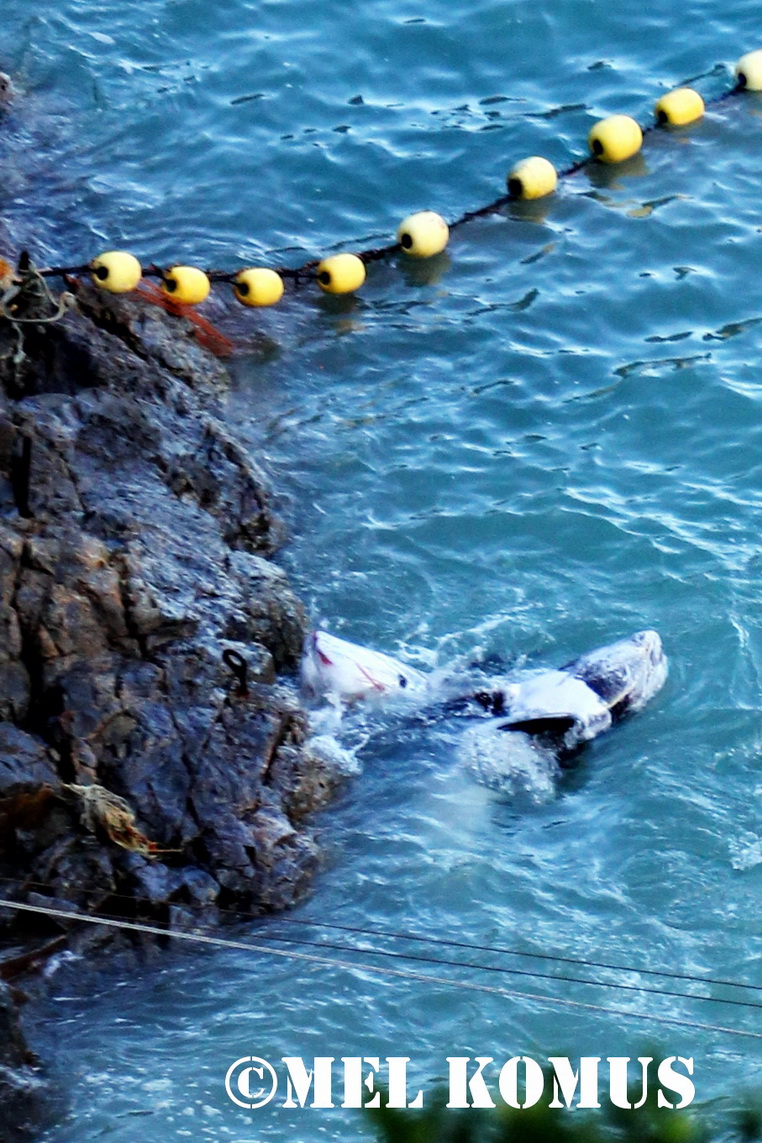
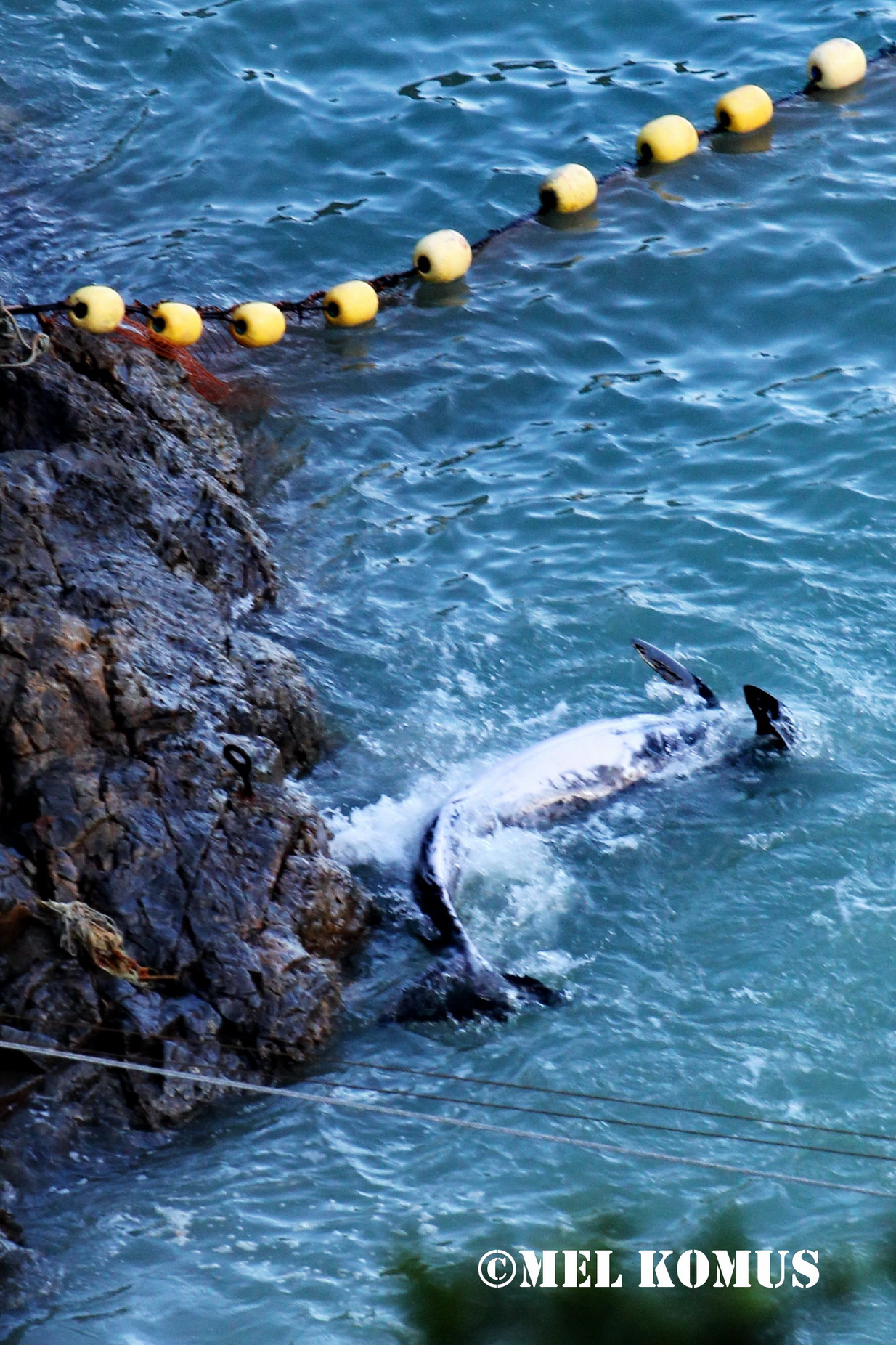
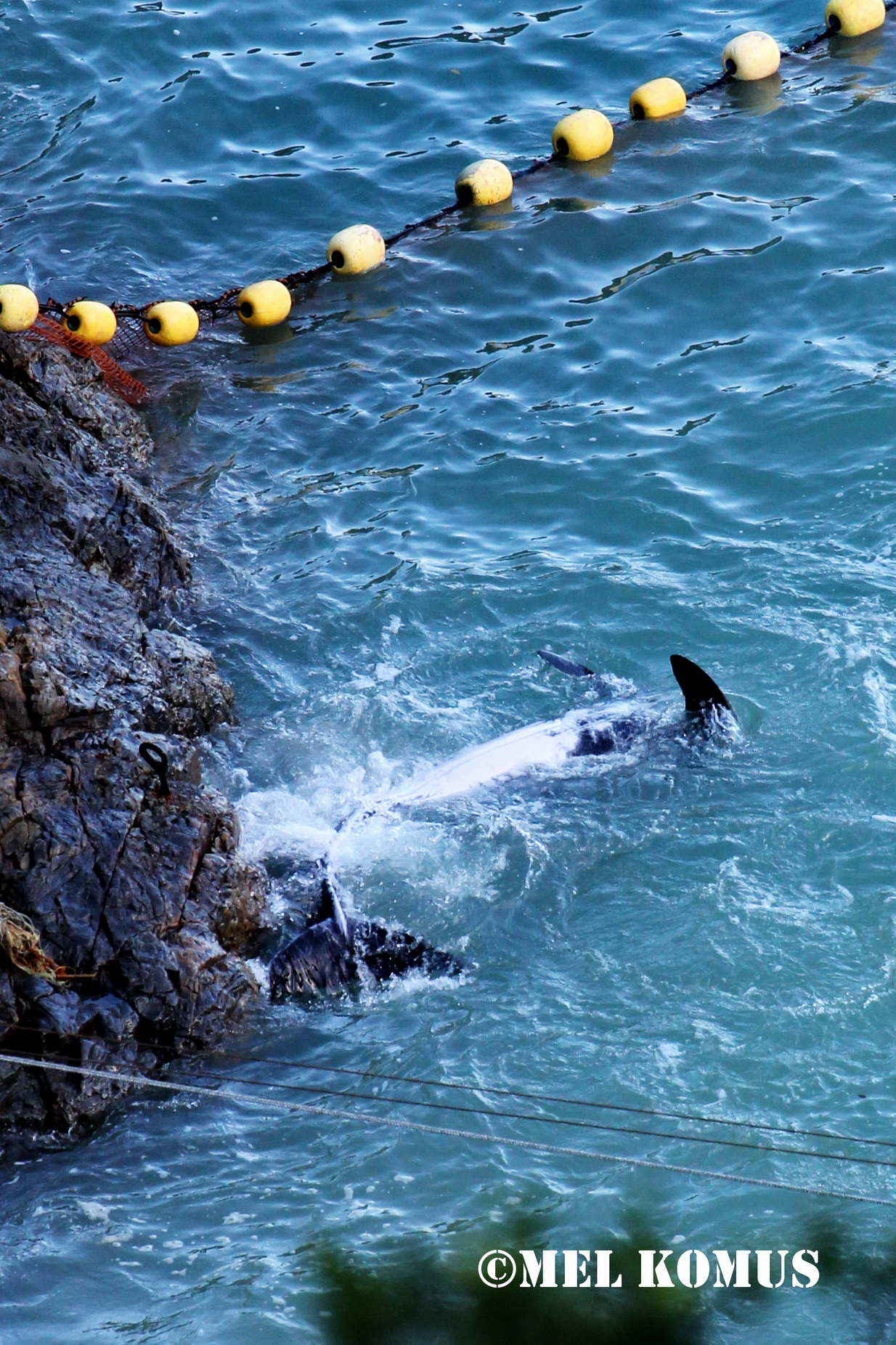
December 20, 2013 – this will be one slaughter and one moment I will surely never forgot. Every day in Taiji is different and every slaughter is different, and each day you experience a roller coaster of emotions. The images from this day seem to be with me at all times and replay almost every night in mind.

This day it was a pod of 10 Risso dolphins that were driven into the cove  and the killing boats seemed to waste no time as they drove this pod for over an hour into the cove, where they would spend their last moments together.

1497698_267952930021611_1346154344_n

Risso dolphins are typically known to be very docile. However, this pod of dolphins displayed their awareness of the impending slaughter and in fear they began to throw themselves onto the rocky walls of the cove as they were netted off.

1480505_267952960021608_1757726316_n

I remember standing above the Cove watching these Risso dolphins spend their last moments together before the slaughter began.  I was following a few dolphins through my lens and snapping many photos. Within moments, I saw this Risso throw himself onto the rocks. My immediate reaction honestly was: I gasped and wanted to shout out a few profanities at the killers below, but I was standing right next to the livestream and managed to think before speaking. Then the tears came and my initial reaction was that I wanted to step back and compose myself, but in an instant like this your adrenaline takes over. I knew I was there for one reason: get the best shots possible of what was happening. So in a split second while crying and barely being able to see clearly through my camera, I took as many possible photos as I could. I remember standing there, beside my fellow Cove Guardian, Hunter, my gasp had got his attention and his quick thinking allowed this to be caught on the livestream as well, but he also leaned over and asked if I was alright,  I just waved him off, struggled to say yeah and kept shooting. Hunter commented later that day saying ” You were on a mission and like a machine, all I could hear was the snap, snap, snap of your camera.” In that moment I was very thankful for one thing … the high speed continuous shooting mode on my camera. And Hunter was right, I was on a mission, to expose the brutality of the slaughter and be able to have the photos to display the awareness dolphins have of the situation they are in. This dolphin clearly knew he was in danger, was frightened and thought the only possible way out was to throw himself on the rocky wall of the cove.

Below are a few more photos in the sequence I shot them of this particular event in the Cove that day. Even though this happened a month ago, I remember it as if it was yesterday.

IMG_9557_resize

IMG_9559_resize

IMG_9560_resize

IMG_9562_resize

IMG_9564_resize

IMG_9565_resize

The photos speak for themselves, and as I saw this dolphin throw itself onto to rocks, it tore my heart and soul apart in just a few moments. In the end I was able to walk away from this experience, however this Risso and the rest of the pod lost their lives in the bloody confines of the infamous cove and eventually wound up lifeless on the butcher house floor.

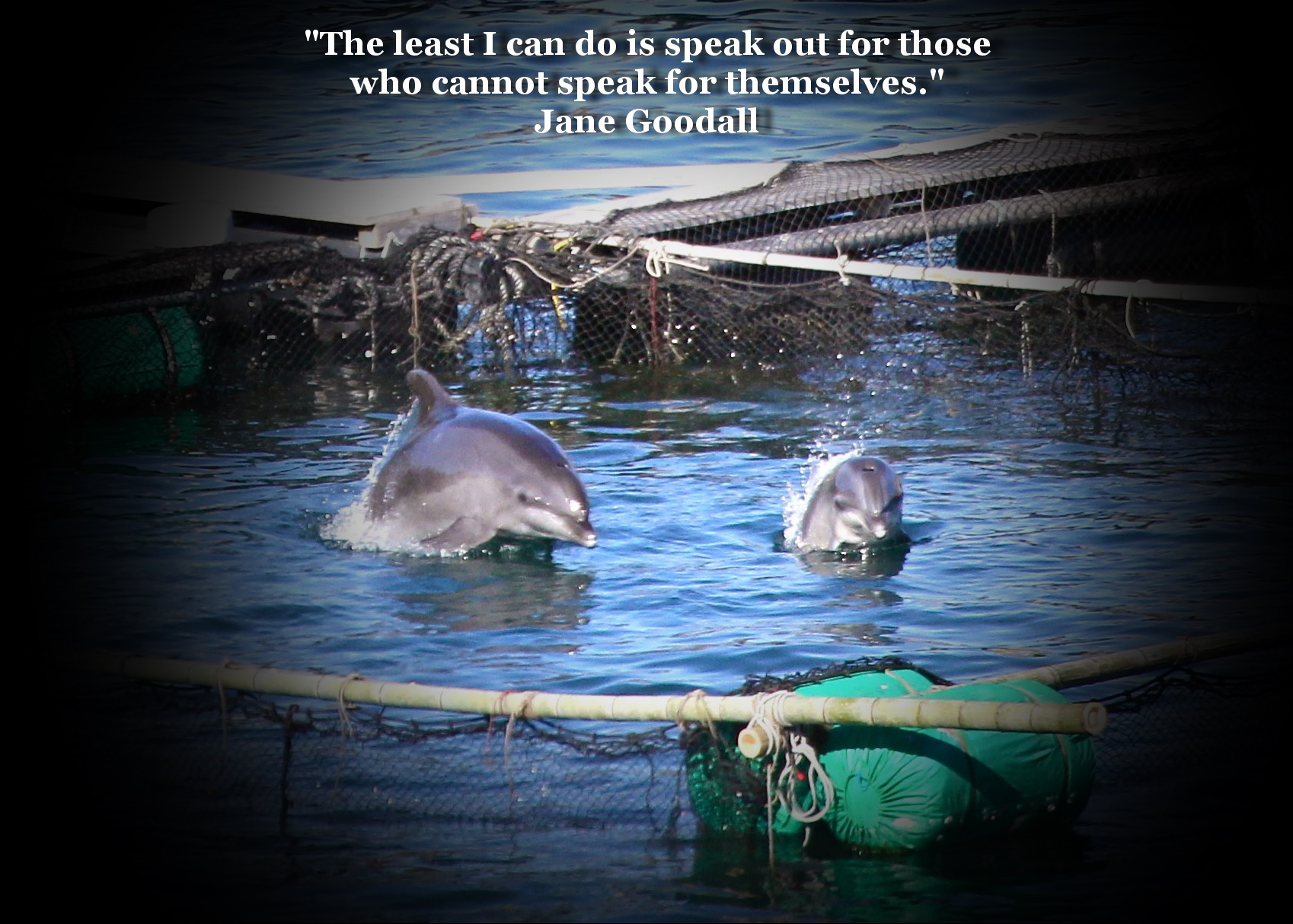
While being a Cove Guardian is a challenging experience, it is one I will not soon forget and an experience I will choose to do again. Why? Because it is just as Jane Goodall puts it “The least I can do is speak out for those who cannot speak for themselves.”

I leave you with one final phrase “Luctor et Emergo” translated as, “Struggle and Emerge.” This is the school motto of Athol Murray College of Notre Dame, where I had the privilege to attend high school. Notre Dame is an integral part of the person I have become today and these word are with me all the time and most certainly helped me to struggle and emerge from my time in Taiji, as an even stronger voice for the dolphins.

For the dolphins!

IMG_3670Edit_resize